Dental Implants After Oral Cancer: Restoring Your Bite
Need expert consultation? Book an appointment with Dr. Pradeep S. or Dr. Kalpa Pandya.
Book AppointmentSurviving oral cancer is a monumental milestone, but the surgical treatments required to eliminate the disease often leave lasting changes in the mouth. When a tumor is removed from the tongue, jaw, cheek, or palate, patients frequently experience tooth loss and structural changes to their jawbone. These changes can make simple daily activities—like chewing, speaking clearly, and smiling confidently—incredibly challenging.
Historically, patients had to adapt to these functional deficits. Today, advanced reconstructive techniques and dental implants offer a highly predictable pathway to recovery. Utilizing dental implants after oral cancer surgery restoring your bite is not just about aesthetics; it is a vital phase of functional oral rehabilitation that helps patients regain their nutritional health, speech clarity, and overall quality of life.
At Mouth Cancer Surgeons in Chennai, our dual-surgeon team—Dr. Pradeep S. and Dr. Kalpa Pandya—works collaboratively to guide patients through this entire process. From the initial oncology diagnosis and tumor resection to advanced microvascular reconstruction and final dental implant placement, we ensure that your functional rehabilitation is planned from day one. Dental implants sit inside our wider recovery and rehabilitation plan after oral cancer surgery.
Understanding the Challenge: Jaw and Tooth Loss After Cancer Surgery
To understand why specialized teeth replacement after tumor surgery is necessary, it helps to look at how oral cancer treatment alters the anatomy of the mouth.
Depending on the stage and location of the tumor, a surgical resection may involve:
-
Segmental Mandibulectomy: Removing a portion of the lower jawbone (mandible).
-
Maxillectomy: Removing a portion of the upper jaw or hard palate.
-
Glossectomy: Removing a portion of the tongue, which affects how food is moved around the mouth during chewing.
-
Soft Tissue Resection: Removing parts of the inner cheek (buccal mucosa) or floor of the mouth, which reduces the natural tissue depth that normally supports traditional dentures.
When bone and teeth are removed, the remaining jaw segments can shift due to muscle pull, leading to a misaligned bite (malocclusion). Additionally, radiation therapy—often a critical part of multidisciplinary cancer care—can damage the salivary glands. This results in chronic dry mouth (xerostomia), which makes wearing traditional plastic dentures highly uncomfortable, as the lack of saliva leads to painful friction ulcers on delicate mucosal tissues.
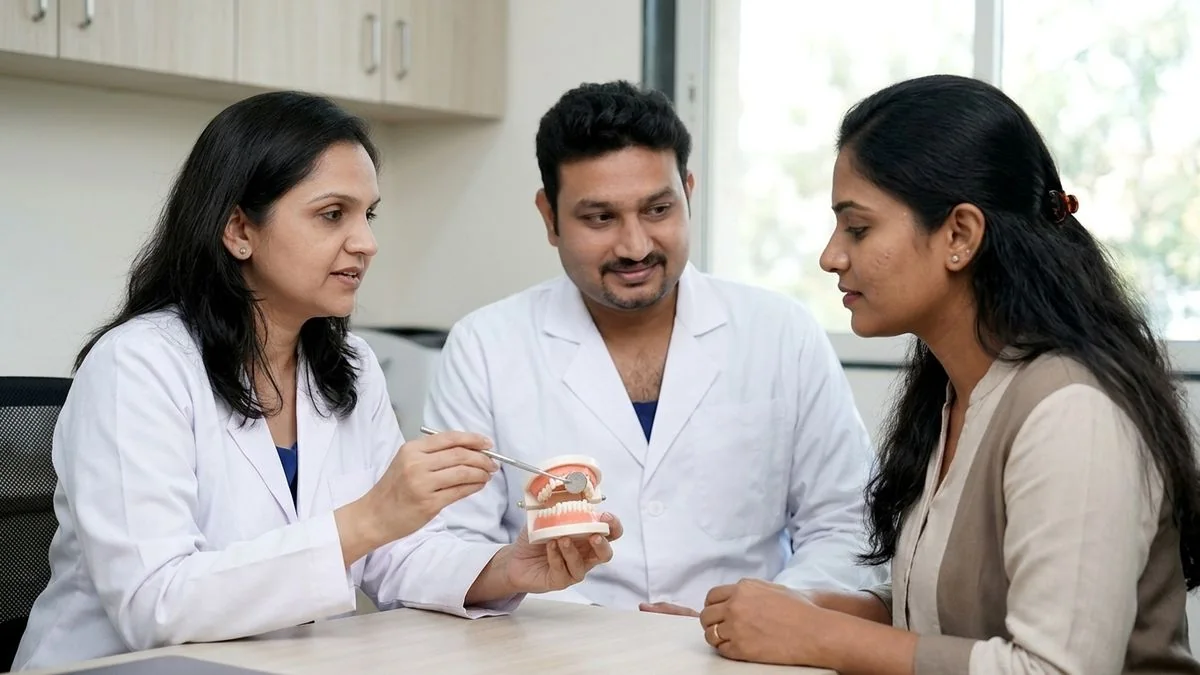
The Role of Jaw Reconstruction in Bite Restoration
Before dental implants can be placed, there must be a stable, healthy bone foundation to support them. If a significant portion of the jawbone was removed during oral cancer surgery, the bone must be rebuilt. This is known as reconstructive and restorative surgery.
The gold standard for rebuilding the jaw is microvascular free tissue transfer. During this procedure, a segment of bone along with its blood vessels is taken from another part of the patient's body and transplanted to the face. The blood vessels of the graft are meticulously connected to blood vessels in the neck under a microscope to ensure the transplanted bone remains alive and healthy.
Common donor sites include:
-
Fibula Free Flap: The fibula (the thin bone in the lower leg) is the most common choice for rebuilding the lower or upper jaw. It offers a long, straight segment of dense bone that is ideal for holding dental implants.
-
Scapula Free Flap: Bone taken from the shoulder blade, often used for complex upper jaw or facial defects.
-
Iliac Crest Free Flap: Bone taken from the hip, which naturally matches the curved shape of the lower jaw.
Once the transplanted bone has healed and fused with the remaining natural jawbone, it acts exactly like a natural jaw. This reconstructed bone provides the precise depth and density required to anchor dental implants securely.
How Dental Implants After Oral Cancer Surgery Restoring Your Bite Works
A dental implant is a small, bio-compatible titanium post that serves as an artificial tooth root. It is surgically inserted into the jawbone, where it undergoes a biological process called osseointegration—the direct structural and functional connection between living bone and the surface of the implant.
For cancer survivors, dental implants offer distinct mechanical advantages over other teeth-replacement options:
-
Direct Bone Anchorage: Because the implants are fused directly into the reconstructed bone (such as a fibula graft), they do not rely on fragile gum tissues for support.
-
Preservation of Surrounding Bone: Implants stimulate the surrounding bone during chewing, preventing the bone loss and shrinkage that naturally occurs when teeth are missing.
-
Bite Force Distribution: Implants distribute the heavy forces of chewing directly into the bone, mimicking natural teeth. This prevents localized pressure points on reconstructed tissues.
-
Stability Without Saliva: Unlike removable dentures that require saliva to create suction and lubrication, implant-supported teeth are fixed in place and do not cause friction sores in dry mouths.
In our Chennai practice, we utilize state-of-the-art virtual surgical planning (VSP). This technology allows Dr. Pradeep S. and Dr. Kalpa Pandya to digitally plan both the jaw reconstruction and the exact placement of the dental implants before the patient ever enters the operating room. This ensures the reconstructed jaw is positioned perfectly to allow for an optimal, natural bite.
Timing of Implant Placement: Immediate vs. Delayed
One of the most common questions patients ask is: “When can I get my dental implants?” The timing of implant placement depends on several factors, including the stage of the cancer, the type of reconstruction, and whether radiation therapy is required.
1. Immediate Implant Placement (Primary Placement)
In select cases, dental implants can be placed into the reconstructed bone graft during the very same surgery performed to remove the tumor and rebuild the jaw.
-
Pros: Reduces the number of subsequent surgeries, shortens the overall rehabilitation time, and allows the patient to receive transitional teeth much sooner.
-
Cons: Highly complex; requires a stable patient who does not have high-risk features that might necessitate urgent, high-dose postoperative radiation.
2. Delayed Implant Placement (Secondary Placement)
More commonly, implants are placed as a secondary procedure, typically 6 to 12 months after the primary cancer surgery.
-
Pros: Allows the surgical team to monitor the patient for any signs of local cancer recurrence during the critical early recovery phase. It also ensures that the reconstructed bone graft has fully healed and established a robust blood supply.
-
Cons: Requires an additional minor surgical procedure and extends the time the patient must go without fixed teeth.
Dental Implants After Radiation Therapy: Special Considerations
Radiation therapy is highly effective at destroying remaining cancer cells, but it also affects healthy tissues. Radiation reduces the number of small blood vessels within the jawbone (hypovascularity), which can slow down healing and slightly lower the success rate of osseointegration.
Managing the Risks of Radiation
While radiation therapy introduces challenges, it does not mean you cannot have dental implants. We take specific, evidence-based precautions to ensure safety:
-
The Safe Window: We typically wait at least 6 to 12 months after the completion of radiation therapy before placing implants. This allows the bone tissue to recover from the acute effects of radiation.
-
Hyperbaric Oxygen Therapy (HBOT): In cases where high-dose radiation was delivered to the jaw, we may recommend HBOT. This involves breathing pure oxygen inside a pressurized chamber for several sessions before and after implant surgery. HBOT stimulates the growth of new blood vessels in the irradiated bone, significantly improving implant success rates and protecting against osteoradionecrosis (bone damage).
-
Meticulous Surgical Technique: Dr. Pradeep S. and Dr. Kalpa Pandya use highly conservative, gentle surgical techniques to minimize trauma to irradiated bone and soft tissues.
The Step-by-Step Rehabilitation Process
Restoring your bite with dental implants after cancer surgery is a structured, multi-phase process that requires close coordination between our surgical team and restorative specialists.
[Phase 1: Tumor Removal & Reconstruction]
â
â¼
[Phase 2: Healing & Cancer Surveillance] (3–12 months)
â
â¼
[Phase 3: Dental Implant Placement]
â
â¼
[Phase 4: Osseointegration (Healing)] (3–6 months)
â
â¼
[Phase 5: Prosthetic Fitting & Bite Calibration]
Phase 1: Tumor Resection and Jaw Reconstruction
The tumor is removed with clean margins. If the jawbone is involved, Dr. Pradeep S. performs microvascular reconstruction using a bone graft (typically a fibula free flap) to rebuild the facial framework.
Phase 2: Healing and Cancer Surveillance
The patient recovers from surgery and completes any necessary adjuvant therapies (radiation or chemotherapy). During this period, which lasts several months, we conduct regular follow-up scans and clinical exams to ensure the mouth remains cancer-free.
Phase 3: Dental Implant Placement
Once cleared for rehabilitation, Dr. Kalpa Pandya performs a precise, minor surgical procedure to place the titanium implant posts into the reconstructed jawbone. This is often done using custom-made surgical guides to ensure perfect alignment.
Phase 4: Osseointegration
The implants are left undisturbed for 3 to 6 months to allow the bone to grow tightly around them. A temporary, non-load-bearing prosthesis may be provided during this time for basic appearance.
Phase 5: Prosthetic Fabrication and Bite Calibration
Once the implants are firmly integrated, digital impressions are taken. A customized dental prosthesis (a bridge or fixed denture) is fabricated. Dr. Kalpa Pandya carefully calibrates the bite to ensure that chewing forces are balanced equally across the jaw, preventing strain on the temporomandibular joints (TMJ).
Comparing Teeth Replacement Options After Oral Cancer
To understand why dental implants are highly recommended, it is helpful to compare them with traditional tooth replacement options in the context of cancer recovery:
| Feature | Dental Implants (Fixed) | Traditional Removable Dentures | Obturators (For Palatal Defects) |
|---|---|---|---|
| Stability during chewing | Excellent; anchored directly in the bone. | Poor; easily dislodged due to altered anatomy. | Moderate; relies on remaining teeth/tissue clasps. |
| Comfort | High; feels and functions like natural teeth. | Low; often causes sore spots on dry, irradiated gums. | Moderate; can be bulky but essential for sealing defects. |
| Impact on speech | Excellent; allows natural tongue movement. | Variable; can slip, causing slurred speech. | Good; blocks air escape into the nasal cavity. |
| Bone preservation | Yes; stimulates and maintains jawbone density. | No; accelerates bone loss over time. | No; does not stimulate underlying bone. |
| Durability | Long-term; can last a lifetime with proper care. | Short-term; requires frequent adjustments or relining. | Moderate; requires periodic replacement as tissues change. |
Life After Restoration: Caring for Your New Bite
Once your implant-supported teeth are fitted, maintaining excellent oral hygiene is vital to long-term success. While titanium implants cannot get cavities, the surrounding gum tissue and bone can still develop infections (peri-implantitis) if plaque is allowed to build up.
If you have experienced dry mouth due to radiation therapy, you are at a higher risk for plaque accumulation. We recommend:
-
Using specialized soft-bristled toothbrushes, interdental brushes, or water flossers to clean hard-to-reach areas around the implants.
-
Using alcohol-free, hydrating mouthwashes to manage dry mouth symptoms.
-
Attending regular professional dental cleanings and surveillance visits at our Chennai clinic every 3 to 6 months.
With diligent home care and regular follow-ups, dental implants have a long-term success rate of over 90% in reconstructed jaws, providing a lifetime of functional, reliable chewing.
Why Choose Mouth Cancer Surgeons for Your Rehabilitation?
Rehabilitating the mouth after oral cancer is one of the most challenging areas of maxillofacial surgery. It requires an in-depth understanding of cancer biology, reconstructive microsurgery, and the mechanics of dental occlusion.
At Mouth Cancer Surgeons, Chennai, we offer a unique, integrated care model:
-
The Dual-Surgeon Advantage: Dr. Pradeep S. (specializing in head and neck oncology and microvascular reconstruction) and Dr. Kalpa Pandya (specializing in OPMDs, jaw pathology, and dental implant rehabilitation) collaborate on every single case. The same two surgeons who diagnose and treat your cancer are the ones who reconstruct your jaw and place your dental implants. This ensures seamless continuity of care.
-
Advanced Hospital Infrastructure: Our primary surgical procedures are performed at Apollo Main Hospital, Greams Road, Chennai, offering access to state-of-the-art intensive care, advanced imaging, and multidisciplinary oncology support. Dr. Kalpa Pandya also consults at Sri Ramachandra Medical Centre, Porur, providing convenient options for patients across Chennai and South India.
-
Personalized, Patient-Centric Care: We understand that cancer recovery is a deeply emotional journey. We treat our patients like family, taking the time to explain every step, manage expectations realistically, and provide compassionate support from your first consultation through to your long-term follow-ups.
If you or a loved one is preparing for oral cancer treatment, or if you have already completed treatment and are struggling with tooth loss and difficulty chewing, early consultation is important. Book an appointment with Dr. Pradeep S. and Dr. Kalpa Pandya at Apollo Main Hospital, Greams Road, Chennai.
References
-
Kovács, F. M., et al. "Evaluation of dental implant survival in patients reconstructed with fibula free flaps after oral cancer resection." Journal of Cranio-Maxillofacial Surgery, 2019.
-
Shaw, R. J., et al. "Primary versus secondary dental implant placement in microvascular reconstructed jaws: A systematic review." International Journal of Oral and Maxillofacial Surgery, 2021.
-
Bodard, A. G., et al. "Impact of hyperbaric oxygen therapy on dental implant survival in irradiated oral cancer patients." Head & Neck, 2020.
-
National Comprehensive Cancer Network (NCCN). "NCCN Clinical Practice Guidelines in Oncology: Head and Neck Cancers." Version 2.2024. NCCN Guidelines
-
Chiapasco, M., et al. "Dental implants in reconstructed jaws after tumor resection: A 10-year retrospective study." Clinical Oral Implants Research, 2018.
Next step
Concerned about a symptom you read here? Get a specialist opinion in Chennai.
Dr. Pradeep S. and Dr. Kalpa Pandya consult at Apollo Hospitals, Greams Road. Same-day responses on WhatsApp for most enquiries.
Dr. Pradeep S.
MDS (OMFS) · FHNS · FIBCSOMS

Dr. Kalpa Pandya
MDS (OMFS) · FHNS — Head & Neck Oncology
Authored by
Medically reviewed by