Gutka & Pan Masala Mouth Cancer Risk: Chennai Expert Guide
Need expert consultation? Book an appointment with Dr. Pradeep S. or Dr. Kalpa Pandya.
Book AppointmentThe consumption of smokeless tobacco products like gutka, pan masala, mawa, and khaini remains a primary driver of oral health crises across India. In Chennai and the wider Tamil Nadu region, oral oncologists observe a high volume of patients presenting with severe, debilitating oral conditions directly linked to these habits.
Understanding the biological mechanisms, early red flags, and clinical progression of gutka-induced oral damage is crucial for early intervention. When caught in the precancerous stage, tissue changes can be managed effectively, preventing progression to invasive malignancies.
At Mouth Cancer Surgeons in Chennai, our dual-surgeon team—Dr. Pradeep S. and Dr. Kalpa Pandya—regularly treats patients dealing with the consequences of smokeless tobacco use. This guide details how these substances damage oral tissues, how to recognize early warnings, and the clinical pathways available to restore both health and function.
The Biological Mechanisms: How Gutka and Pan Masala Mutate Oral Cells
To understand the severe gutka and pan masala mouth cancer risk in Chennai, we must look at the chemical composition of these substances. Gutka is a manufactured mixture of crushed areca nut (supari), tobacco, slaked lime (chuna), paraffin wax, and sweetening or flavoring agents. Pan masala is a similar mixture, often marketed as tobacco-free, yet it remains highly carcinogenic due to its high concentration of areca nut. This is why plain supari is not a safe alternative, and why oral cancer in non-smokers is more common than most patients expect.
When these substances are placed in the buccal sulcus (the space between the cheek and gums) and chewed, they release a cocktail of toxic chemicals that interact with the delicate lining of the mouth:
-
Chemical Carcinogenesis: Tobacco contains over 28 known carcinogens, most notably Tobacco-Specific Nitrosamines (TSNAs) like NNN and NNK. These chemicals directly bind to oral epithelial cell DNA, causing genetic mutations that disrupt normal cell growth, division, and death cycles.
-
Mechanical and Chemical Abrasions: Slaked lime (calcium hydroxide) acts as an alkaline agent that facilitates the rapid absorption of nicotine and other chemicals into the bloodstream by altering the local pH. However, slaked lime is also highly corrosive. It causes chronic micro-abrasions and chemical burns on the mucosal lining, stripping away the protective superficial layers of epithelial cells.
-
Areca Nut Alkaloids: Areca nut contains specific alkaloids, primarily arecoline, arecaidine, and guvacoline. Arecoline stimulates fibroblasts (the cells responsible for producing connective tissue) to synthesize excessive amounts of collagen. Concurrently, it inhibits collagenase, the enzyme responsible for breaking down excess collagen. This double action leads to a dense, irreversible buildup of scar-like tissue beneath the oral mucosa.
This continuous cycle of mechanical trauma, chemical irritation, and cellular mutation creates an environment where normal cells gradually transition from healthy tissue to precancerous states, and eventually into invasive squamous cell carcinoma.
Oral Submucous Fibrosis (OSMF): The Precursor to Malignancy
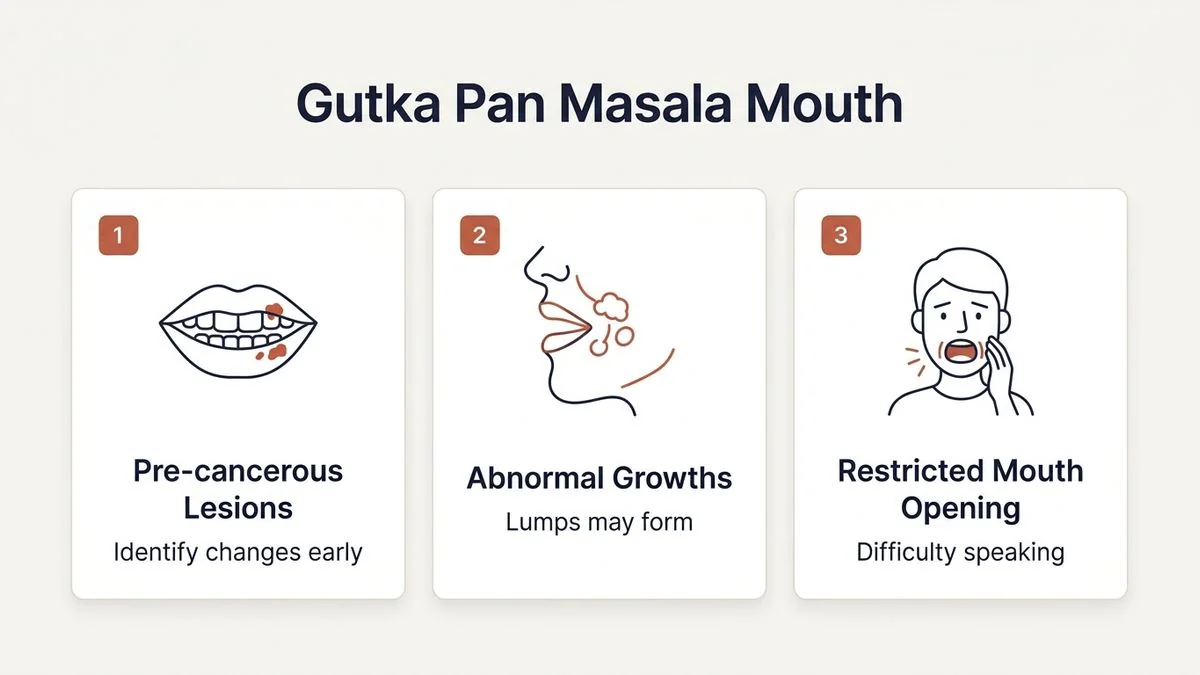
One of the most common consequences of chewing pan masala and gutka is a chronic, progressive condition known as Oral Submucous Fibrosis (OSMF). In our practice, we frequently consult patients who present with a gradual loss of oral mobility, often realizing there is a problem only when they can no longer eat their favorite foods or brush their teeth properly.
The Pathophysiology of OSMF
As arecoline drives excessive collagen deposition, the normally soft, elastic lining of the cheeks, lips, and palate becomes rigid. Fibrotic bands form within the submucosal layers, effectively tethering the tissues of the mouth.
[Continuous Gutka/Areca Nut Chewing]

                │

                ▼

[Slaked Lime Micro-abrasions + Alkaloid Release]

                │

                ▼

[Chronic Inflammation & Hyper-activation of Fibroblasts]

                │

                ▼

[Excessive Collagen Production + Reduced Collagen Breakdown]

                │

                ▼

[Formation of Dense, Rigid Submucosal Fibrotic Bands]

                │

                ▼

[Oral Submucous Fibrosis (OSMF) & Trismus (Locked Jaw)]
Key Symptoms of OSMF to Watch For:
-
Progressive Trismus (Inability to open the mouth): This is the hallmark sign. A healthy adult can typically open their mouth wide enough to fit three or four fingers vertically (approximately 35-50 mm). In advanced OSMF, this can reduce to less than 10 mm, severely impacting eating, speaking, and oral hygiene.
-
Intense Burning Sensation (Mucosal Burning): Patients often experience severe pain and burning when consuming spicy, salty, or acidic foods. This occurs because the protective outer layer of the oral lining (epithelium) becomes extremely thin and atrophic, leaving nerve endings exposed.
-
Blanching of the Mucosa: The inside of the cheeks and lips loses its healthy pink color, appearing marble-white, pale, or shiny.
-
Loss of Tongue Mobility: Fibrosis can affect the floor of the mouth and the tongue, making it difficult to protrude or move the tongue from side to side, which impairs speech and swallowing.
If you are experiencing any of these symptoms, seeking an expert clinical evaluation is vital. To learn more about how we diagnose and manage these conditions, read our guide on Oral Precancer (OPMD).
Recognizing the Early Signs of Mouth Cancer
While OSMF is a highly significant precursor, gutka and pan masala use can also lead directly to other Oral Potentially Malignant Disorders (OPMDs) or frank malignancy. Recognizing the early signs of mouth cancer from chewing tobacco can save lives, as early-stage oral cancers have a survival rate exceeding 80% when treated promptly.

Patients should perform regular self-examinations and look for the following warning signs:
1. Persistent Red or White Patches
-
Leukoplakia: These are flat, raised, or textured white patches on the gums, tongue, or inside of the cheeks that cannot be scraped off. They are a response to chronic irritation and carry a risk of turning cancerous.
-
Erythroplakia: These are bright red, velvety patches that develop on the mucosal lining. Erythroplakia is far more dangerous than leukoplakia, with a very high rate of dysplasia (abnormal cells) and malignant transformation.
-
Erythroleukoplakia: A mixed red-and-white patch that carries an exceptionally high risk of harboring cancer cells.
2. Non-Healing Ulcers
A standard mouth ulcer (aphthous ulcer) caused by accidental biting or stress typically heals within 10 to 14 days. An ulcer that persists for more than three weeks, especially in a gutka user, must be treated with high clinical suspicion. These lesions are often painless in their early stages, which unfortunately leads many patients to delay seeking care. For a detailed breakdown of how to identify suspicious sores, refer to our article on whether a mouth ulcer could be cancer.
3. Unexplained Lumps, Swelling, or Induration
The development of a hard lump or thickening in the cheek, tongue, or gums is a key indicator of tissue changes. "Induration" refers to a firm, hardened feel to the tissue when pressed, which occurs as cancer cells invade deeper muscular and connective tissue layers.
4. Difficulty Chewing, Swallowing, or Moving the Jaw
As tumors grow or fibrosis deepens, they restrict the normal movement of the muscles and joints responsible for chewing and swallowing. Pain that radiates to the ear (referred otalgia) without an ear infection is another warning sign that a deep-seated oral lesion may be affecting local nerves.
Comparing Gutka-Induced Oral Lesions
| Lesion Type | Clinical Appearance | Malignant Transformation Risk | Common Locations | Primary Action Required |
|---|---|---|---|---|
| Oral Submucous Fibrosis (OSMF) | Marble-white, rigid mucosa; palpable fibrous bands; limited mouth opening. | 7% – 13% | Buccal mucosa (cheeks), retromolar trigone, palate. | Immediate cessation, medical therapy, regular monitoring. |
| Homogeneous Leukoplakia | Uniformly white, flat, or slightly wrinkled patch with smooth margins. | Low to Moderate (1% – 5%) | Lateral borders of tongue, floor of mouth, cheeks. | Biopsy, elimination of irritants, close surveillance. |
| Non-Homogeneous / Speckled Leukoplakia | Mixed red and white patch; may be nodular, ulcerated, or bumpy. | High (20% – 30%) | Tongue, floor of mouth, buccal mucosa. | Prompt surgical excision or laser ablation; biopsy. |
| Erythroplakia | Smooth, velvety, fiery red patch with well-defined borders. | Very High (up to 90% show dysplasia or cancer) | Floor of mouth, soft palate, lateral tongue. | Mandatory urgent biopsy and complete surgical removal. |
| Squamous Cell Carcinoma (SCC) | Indurated, non-healing ulcer with raised, rolled borders; or an exophytic mass. | N/A (Already Malignant) | Tongue, buccal mucosa, lower alveolus (gum line). | Urgent staging, Oral Cancer Surgery, and multidisciplinary oncology care. |
Gutka and Pan Masala Mouth Cancer Risk in Chennai: Local Trends
In Chennai and across South India, the profile of oral cancer patients has evolved. Historically, oral cancer was primarily diagnosed in older men with a long history of smoking and alcohol consumption. However, the widespread availability of cheap, highly addictive smokeless tobacco products has altered this demographic.
At our practice, we are seeing an increasing number of young adults—often in their 20s and 30s—presenting with advanced OSMF and early-stage oral squamous cell carcinoma. Many of these patients began chewing gutka or pan masala during their teenage years, unaware of the rapid pace at which these chemical formulations can damage young oral tissues.
[Youth Exposure to Gutka/Pan Masala]

                │

                ▼

[Rapid Development of severe OSMF (within 2-5 years)]

                │

                ▼

[Early Dysplasia (Cellular Changes) in Young Adults]

                │

                ▼

[Presentation with Oral Cancer at an Early Age (20s-30s)]
Furthermore, the habit of keeping the tobacco quid in the cheek pouch for extended periods, or even sleeping with it, leads to prolonged, concentrated exposure of the buccal mucosa to carcinogens. This localized contact is why buccal mucosa cancer and cancer of the alveolus (gums) are exceptionally prevalent in our local patient population.
If you or a loved one are experiencing symptoms or want to understand your risks better, scheduling an oral cancer screening is a crucial step toward protecting your health.
The Diagnostic Pathway at Mouth Cancer Surgeons
When a patient visits Dr. Pradeep S. and Dr. Kalpa Pandya at Apollo Main Hospital, Greams Road, Chennai, they receive a comprehensive clinical evaluation. We utilize a systematic, evidence-based diagnostic protocol to ensure no lesion is missed and every patient receives an accurate diagnosis.
Step 1: Detailed Clinical Examination
We perform a thorough visual and tactile examination of the entire oral cavity under high-quality illumination. This includes palpating the cheeks, tongue, floor of the mouth, gums, and neck lymph nodes to check for any hidden lumps, tissue firmness, or swelling.
Step 2: Diagnostic Adjuncts (When Needed)
To help identify mucosal changes that may not be fully visible to the naked eye, we may use specialized diagnostic aids:
-
Toluidine Blue Staining: A diagnostic dye that preferentially stains cells with high DNA content (like cancer cells), highlighting areas that require targeted biopsy.
-
Velscope / Autofluorescence Imaging: A non-invasive light-based tool that reveals changes in tissue health by highlighting alterations in natural mucosal fluorescence.
Step 3: Biopsy (The Gold Standard)
If we identify a suspicious patch, chronic ulcer, or tissue thickening, a biopsy is essential. A biopsy is a simple, quick outpatient procedure performed under local anesthesia. A tiny sample of the affected tissue is gently removed and sent to an oral pathologist.
The pathology report determines whether the tissue is benign, shows precancerous changes (dysplasia ranging from mild to severe), or contains malignant cancer cells.
Management and Treatment Strategy
Treatment depends entirely on the stage of the disease. At Mouth Cancer Surgeons, our dual-surgeon model ensures that the same two specialists guide you through every stage of care, from initial diagnosis to surgical treatment and long-term recovery.
Managing Precancerous Conditions (OSMF & Dysplasia)
If the diagnosis is OSMF or a precancerous lesion like leukoplakia, the primary goals are to stop the progression to cancer, improve mouth opening, and relieve pain:
-
Strict Cessation Support: Complete elimination of tobacco, areca nut, and alcohol is mandatory. We provide structured guidance to help patients overcome addiction.
-
Medical Therapy: For mild to moderate OSMF, we utilize localized injections of corticosteroids, hyaluronidase, or placental extracts directly into the fibrotic bands to help break down excess collagen and reduce inflammation. Antioxidant supplements (such as Lycopene) and pentoxifylline are also prescribed to improve mucosal blood flow and tissue health.
-
Surgical Intervention (Fibrotomy): In advanced cases of OSMF where the mouth opening is severely restricted (less than 15-20 mm), surgical intervention may be necessary. This involves releasing the tight fibrotic bands inside the cheeks and placing skin or mucosal grafts to maintain the newly gained opening.
If you are experiencing severe jaw restriction, early intervention is important. Book an appointment with Dr. Pradeep S. and Dr. Kalpa Pandya at Apollo Main Hospital, Greams Road, Chennai, to discuss your options.
Surgical Treatment for Oral Cancer
If a biopsy confirms oral squamous cell carcinoma, surgery is typically the primary treatment modality. Our surgical approach is highly precise, focusing on removing the tumor completely while preserving vital oral functions:
-
Tumor Resection: The primary tumor is removed with a safe margin of healthy surrounding tissue to ensure no microscopic cancer cells are left behind.
-
Neck Dissection: Because oral cancer can spread to the lymph nodes in the neck, we often perform a neck dissection to remove these lymph nodes, preventing further spread and helping to accurately stage the disease.
-
Advanced Reconstructive Surgery: Removing a tumor from the tongue, jaw, or cheek can impact a patient's ability to speak, swallow, and chew. Dr. Pradeep S. and Dr. Kalpa Pandya specialize in microvascular free flap reconstruction. We transfer healthy tissue (such as skin, muscle, or bone from the forearm, thigh, or fibula) to reconstruct the surgical defect, restoring both facial appearance and vital functions. Learn more about these advanced techniques on our reconstructive and restorative surgery page.
Reversing the Damage: The Importance of Quitting Today
A common question we hear in our Chennai clinic is: "If I stop chewing gutka now, will my mouth go back to normal?"
The answer depends on how far the tissue damage has progressed.
-
Early-Stage Changes: If you have mild burning sensations or very early mucosal changes without significant loss of mouth opening, stopping the habit immediately can halt the inflammatory process. Over time, with proper nutrition and medical guidance, the oral mucosa can recover much of its health and elasticity.
-
Advanced OSMF or Established Dysplasia: Once dense fibrotic bands have formed or cells have undergone severe genetic mutations, quitting tobacco alone will not reverse the structural damage. However, quitting is still absolutely critical. It stops further deterioration, dramatically reduces your risk of developing invasive cancer, and allows medical and surgical treatments to be highly effective.
Practical Steps for Tobacco Cessation
-
Identify Triggers: Recognize the times, places, or emotional states that make you reach for gutka or pan masala, and consciously alter your routine.
-
Use Healthy Substitutes: Replace the physical habit of keeping a quid in your mouth with sugar-free chewing gum, fennel seeds (saunf), or cardamom.
-
Seek Professional Support: Nicotine Replacement Therapy (NRT) in the form of gums, lozenges, or patches can ease withdrawal symptoms. Our team can guide you toward safe cessation aids.
-
Regular Professional Monitoring: If you have a history of gutka use, regular visits to an oral surgeon are vital to monitor any persistent tissue changes.
Taking Action for Your Health
The risk of mouth cancer associated with gutka and pan masala is a serious health concern, but it is one that can be managed and prevented with timely action. Recognizing symptoms early—such as a persistent burning sensation, white or red patches, or difficulty opening your mouth—and seeking expert medical advice can make a significant difference in your treatment outcome.
At Mouth Cancer Surgeons, Dr. Pradeep S. and Dr. Kalpa Pandya provide expert, compassionate care for patients dealing with oral precancers, jaw pathology, and advanced head and neck malignancies. Our dual-surgeon approach ensures you receive consistent, high-quality care throughout your treatment journey.
References
-
International Agency for Research on Cancer (IARC). "Betel-quid and Areca-nut Chewing and Some Areca-nut-derived Nitrosamines." IARC Monographs on the Evaluation of Carcinogenic Risks to Humans, Volume 85, 2004. https://publications.iarc.fr/Book-And-Report-Series/Iarc-Monographs-On-The-Evaluation-Of-Carcinogenic-Risks-To-Humans/Betel-quid-And-Areca-nut-Chewing-And-Some-Areca-nut-derived-Nitrosamines-2004
-
Ray, J. G., et al. "Oral Submucous Fibrosis: A Clinicopathological Study in a South Indian Population." Journal of Oral and Maxillofacial Pathology, 2016.
-
National Comprehensive Cancer Network (NCCN). "NCCN Clinical Practice Guidelines in Oncology: Head and Neck Cancers." Version 1.2024. https://www.nccn.org/guidelines
-
Warnakulasuriya, S., et al. "Oral Potentially Malignant Disorders: A Consensus on Terminology, Classification, and Clinical Management." Journal of Oral Pathology & Medicine, 2020. https://onlinelibrary.wiley.com/doi/10.1111/jop.13080
-
World Health Organization (WHO). "Prevention and Control of Oral Cancer in the South-East Asia Region." WHO Regional Office for South-East Asia, 2021.
Next step
Concerned about a symptom you read here? Get a specialist opinion in Chennai.
Dr. Pradeep S. and Dr. Kalpa Pandya consult at Apollo Hospitals, Greams Road. Same-day responses on WhatsApp for most enquiries.

Dr. Pradeep S.
MDS (OMFS) · FHNS · FIBCSOMS

Dr. Kalpa Pandya
MDS (OMFS) · FHNS — Head & Neck Oncology
Authored by
Medically reviewed by