
Jaw Cysts: OKC & Dentigerous Cyst Causes & Recurrence

Need expert consultation? Book an appointment with Dr. Pradeep S. or Dr. Kalpa Pandya.
Book AppointmentDiscovering an unexpected shadow or pocket of fluid on a routine dental X-ray can be deeply unsettling. Many patients are referred to oral and maxillofacial specialists after a panoramic radiograph (OPG) reveals a lesion inside the jawbone. Among the most common non-inflammatory jaw lesions are Odontogenic Keratocysts (OKC) and dentigerous cysts.
While both are classified as developmental odontogenic cysts—meaning they arise from tissues involved in tooth formation—they behave in fundamentally different ways. Understanding the differences in jaw cysts OKC and dentigerous cyst causes surgery and recurrence is vital for patients seeking to make informed decisions about their healthcare.
At Mouth Cancer Surgeons in Chennai, Dr. Pradeep S. and Dr. Kalpa Pandya specialize in diagnosing, treating, and reconstructing complex maxillofacial tumours & jaw pathology. Our dual-surgeon approach ensures that every patient benefits from comprehensive diagnostic planning, precise surgical execution, and meticulous long-term follow-up to prevent recurrence.
Understanding Jaw Cysts: What Are OKC and Dentigerous Cysts?
To understand these lesions, it helps to look at how teeth develop. During embryonic development, specialized epithelial cells form the teeth. Once tooth formation is complete, microscopic remnants of this epithelium can remain trapped within the upper jaw (maxilla) or lower jaw (mandible). Under certain triggers, these cellular remnants can begin to proliferate and secrete fluid, forming a balloon-like, fluid-filled sac known as a cyst.
What is an Odontogenic Keratocyst (OKC)?
An Odontogenic Keratocyst (formerly classified by the World Health Organization as a Keratocystic Odontogenic Tumor or KCOT due to its aggressive nature) is a unique developmental cyst. It is lined by a specific type of keratinizing epithelium. Unlike simple cysts that expand slowly due to internal fluid pressure, an OKC grows through active cellular proliferation of its lining. This aggressive growth pattern allows it to travel rapidly through the marrow spaces of the jawbone, often reaching a massive size before causing any visible facial swelling.
What is a Dentigerous Cyst?
A dentigerous cyst (or follicular cyst) is the second most common type of odontogenic cyst, accounting for approximately 20% of all epithelium-lined cysts in the jaw. It forms around the crown of an unerupted or developing tooth. It is most frequently associated with impacted mandibular third molars (lower wisdom teeth) or maxillary canines. Fluid accumulates between the outer surface of the tooth crown and the surrounding enamel epithelium, gradually expanding into a cyst that encloses the crown while attaching to the tooth's neck.
Root Causes: Why Do OKCs and Dentigerous Cysts Develop?
Patients often ask if poor dental hygiene or physical trauma caused their jaw cyst. In reality, both OKCs and dentigerous cysts are developmental anomalies rather than infections.
Causes of Odontogenic Keratocysts (OKC)
The precise trigger for OKC development remains a subject of ongoing research, but its origins are well-documented:
-
Dental Lamina Remnants: OKCs arise from the remnants of the dental lamina (the cell rests of Serres), which are embryonic bands of tissue that guide early tooth development.
-
Genetic Mutations: Research has linked OKCs to mutations in the PTCH1 (Patched 1) tumor suppressor gene, which is part of the Hedgehog signaling pathway. This pathway regulates cell growth and specialization.
-
Syndromic Association: While most OKCs occur isolated (sporadically), multiple OKCs in a single patient are a hallmark sign of Nevoid Basal Cell Carcinoma Syndrome (NBCCS), also known as Gorlin-Goltz syndrome. Patients with Gorlin-Goltz syndrome require comprehensive genetic evaluation and lifelong surveillance.
Causes of Dentigerous Cysts
The formation of a dentigerous cyst is a mechanical and physiological process linked directly to tooth impaction:
-
Fluid Accumulation: When a tooth fails to erupt through the gums, it remains encased in its developmental follicle. Venous obstruction or altered local blood flow can cause fluid to accumulate between the follicular lining and the tooth crown.
-
Osmotic Pressure: As fluid builds up, osmotic pressure increases, causing the cyst to expand. The cyst gradually resorbs the surrounding bone to make room for its growth.
-
Impacted Teeth: Any factor that prevents a tooth from erupting—such as lack of space in the jaw, dense overlying bone, or abnormal positioning—increases the risk of dentigerous cyst formation.

Key Differences: OKC vs. Dentigerous Cysts
While both cysts present as dark, hollow areas (radiolucencies) on an X-ray, their clinical behavior, microscopic appearance, and risk profiles differ significantly.
| Feature | Odontogenic Keratocyst (OKC) | Dentigerous Cyst |
|---|---|---|
| Origin | Remnants of the dental lamina (Cell rests of Serres) | Enamel epithelium surrounding an unerupted tooth crown |
| Growth Pattern | Aggressive, infiltrative, grows along the internal marrow spaces | Expansile, uniform growth pushing surrounding bone outward |
| Common Location | Posterior mandible (back of lower jaw and ramus) | Surrounding the crown of an impacted wisdom tooth or canine |
| Radiographic Appearance | Well-defined radiolucency, often multilocular (soap-bubble appearance) | Well-defined, unilocular radiolucency attached to the neck of a tooth |
| Recurrence Rate | High (25% to 60% with conservative treatment) | Very low (almost zero after complete removal) |
| Histology | Thin, uniform parakeratinized epithelial lining with palisaded basal cells | Thin, non-keratinized stratified squamous epithelium |
| Syndromic Association | Strongly linked to Gorlin-Goltz Syndrome | None |
Symptoms and Diagnosis: How to Spot a Silent Jaw Cyst
Both OKCs and dentigerous cysts are notoriously "silent" in their early stages. Because they grow slowly inside the bone, they rarely cause pain unless they become infected or grow large enough to structurally weaken the jaw.
Common Signs to Watch For
As these cysts expand, patients may notice:
-
Painless Swelling: A gradual, hard bulge on the outer or inner surface of the jawbone.
-
Tooth Displacement: Teeth near the cyst may tilt, shift, or become loose.
-
Failure of Tooth Eruption: A permanent tooth (like a canine or wisdom tooth) fails to erupt long after its expected timeline.
-
Pain and Discharge: If the cyst becomes infected, it can cause sudden pain, redness, swelling of the gums, and a foul-tasting discharge inside the mouth.
-
Pathologic Fracture: In extreme cases, the cyst hollows out the jawbone so extensively that minor trauma or normal chewing can cause the jaw to fracture.
The Diagnostic Pathway
Because many jaw cysts mimic other benign and malignant tumors (such as ameloblastoma), a precise diagnosis is essential. At our practice in Chennai, we utilize a multi-step diagnostic protocol:
-
Digital Imaging (OPG & CBCT): A panoramic radiograph (OPG) provides a broad view of the jaws. A Cone Beam Computed Tomography (CBCT) scan provides high-resolution, 3D views of the bone, allowing us to see the exact boundaries of the cyst, its relationship to adjacent tooth roots, and its proximity to critical structures like the inferior alveolar nerve.
-
Incisional Biopsy: This is the gold standard for diagnosis. A small window is created in the bone under local anesthesia, and a portion of the cyst lining is removed. This tissue is analyzed under a microscope by an experienced oral pathologist to determine if the lesion is an OKC, a dentigerous cyst, or a more aggressive jaw tumor.
If you are experiencing unexplained jaw swelling, shifting teeth, or have been told you have a shadow on your dental X-ray, early professional evaluation is key. Book a diagnostic consultation with Dr. Pradeep S. and Dr. Kalpa Pandya at Apollo Main Hospital, Greams Road, Chennai.
Surgical Treatment Options for Jaw Cysts
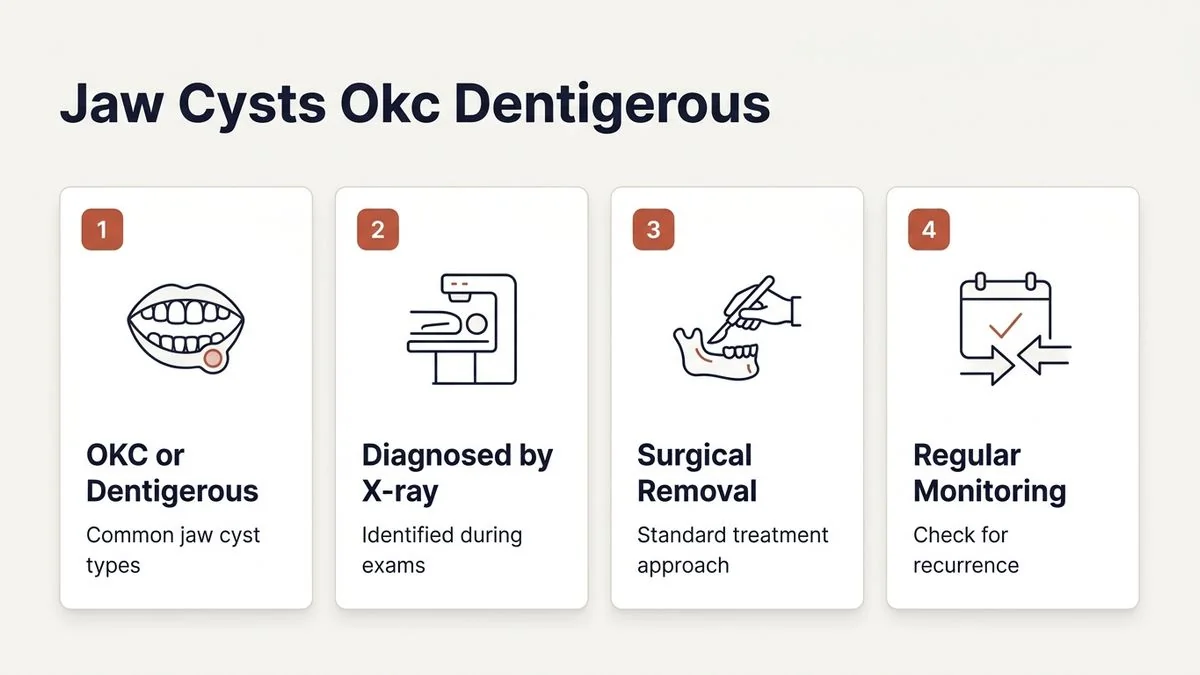
The primary treatment for both OKCs and dentigerous cysts is surgical intervention. The choice of surgical technique depends heavily on the cyst's histopathological diagnosis, size, location, and relationship to neighboring anatomical structures.
1. Enucleation
Enucleation involves stripping or "shelling out" the entire intact cyst lining from its bony cavity, similar to peeling an orange.
-
For Dentigerous Cysts: Enucleation combined with the extraction of the associated impacted tooth is highly curative. If the patient is young and the impacted tooth is in a favorable position, we sometimes preserve the tooth and guide its eruption using orthodontic assistance.
-
For OKCs: Simple enucleation alone is associated with unacceptably high recurrence rates. Therefore, when treating an OKC, we combine enucleation with adjunctive therapies.
2. Enucleation with Chemical Cauterization (Carnoy's or Modified Carnoy's Solution)
After the main mass of an OKC is enucleated, the bony cavity is treated with a chemical agent known as Carnoy's solution for a few minutes. This agent penetrates the superficial bone layers and devitalizes any remaining microscopic cells or daughter cysts without damaging the larger blood vessels or nerves in the area. This combined approach dramatically reduces the recurrence rate of OKCs.
3. Marsupialization (Decompression)
For very large cysts that occupy a significant portion of the jaw or wrap around vital structures (such as the inferior alveolar nerve or the maxillary sinus), immediate aggressive surgery carries risks of nerve damage or jaw fracture.
In these cases, we perform marsupialization. We cut a small surgical window into the cyst wall and suture the edges to the oral mucosa, keeping the cavity open to the mouth. This allows the internal fluid to drain continuously, relieving pressure. Over several months, the jawbone naturally regenerates around the shrinking cyst, making a subsequent, minor surgical removal much safer and less invasive.
4. Marginal or Segmental Resection
In cases of recurrent, highly aggressive OKCs, or when a cyst has destroyed a vast portion of the jawbone, a partial resection of the jaw may be necessary. The involved segment of bone is removed with a safe margin of healthy tissue.
When a resection is required, our dual-surgeon team steps in to perform both the removal and immediate reconstructive and restorative surgery. Using advanced microvascular free tissue transfers (such as a fibula free flap) or titanium reconstruction plates, we reconstruct the jaw contour, ensuring the patient's facial appearance, speech, and ability to chew are preserved.
The Recurrence Challenge: Why Do Some Jaw Cysts Return?
The risk of recurrence is where the management of OKCs and dentigerous cysts diverges most sharply.
Why OKCs Frequently Recur
The recurrence rate for Odontogenic Keratocysts has historically been reported between 25% and 60% when treated with simple enucleation alone. This high recurrence is driven by several biological factors:
-
Thin and Friable Lining: The epithelial lining of an OKC is extremely delicate and easily tears during removal. Small fragments of the lining left behind can regenerate into new cysts.
-
Satellite (Daughter) Cysts: OKCs frequently develop microscopic pocket-like projections within the surrounding bone. If these satellite cysts are not addressed during surgery, they will grow into recurrent lesions.
-
High Cellular Proliferation: The cells of an OKC lining have intrinsic neoplastic-like growth potential, allowing them to regenerate rapidly from minimal remnants.
By utilizing aggressive curettage, peripheral ostectomy (scraping away a thin layer of bone from the cavity), and chemical cauterization, our surgical team reduces the recurrence rate of OKCs to under 8% to 10%.
The Low Recurrence of Dentigerous Cysts
In contrast, dentigerous cysts have an excellent prognosis. Once the cyst lining is completely enucleated along with the removal of the offending tooth, recurrence is exceptionally rare. If a dentigerous cyst does appear to return, it is usually because a small portion of the original follicle was left behind during the primary surgery, or the initial diagnosis was inaccurate.
Post-Surgical Recovery and Long-Term Surveillance
A successful outcome depends not only on the surgery itself but also on meticulous post-operative care and long-term follow-up.
What to Expect During Recovery
-
Pain and Swelling Management: Some swelling and mild discomfort are normal after jaw surgery. We provide comprehensive pain-management protocols to keep patients comfortable.
-
Dietary Adjustments: Patients are placed on a soft or liquid diet for the first few weeks to protect the healing bone and prevent food debris from entering the surgical site.
-
Oral Hygiene: Gentle rinsing with warm salt water or prescribed chlorhexidine mouthwash is recommended to keep the surgical site clean without disturbing the sutures.
-
Bone Healing: While the soft tissues heal within 10 to 14 days, the bone cavity takes 6 to 12 months to completely fill in with new, healthy bone.
The Importance of Surveillance
Because OKCs can recur many years after surgery, patients must commit to a long-term follow-up schedule. We recommend:
-
Periodic clinical examinations and digital radiographs (OPG or CBCT) every 6 months for the first two years.
-
Annual radiographic reviews for at least 5 to 10 years post-surgery.
-
Immediate evaluation if any new swelling, pain, or changes in tooth alignment are noticed.
Why Choose Mouth Cancer Surgeons in Chennai for Jaw Pathology?
When dealing with aggressive jaw lesions like OKCs, choosing the right surgical team is paramount to achieving a cure while preserving your quality of life. At Mouth Cancer Surgeons, we offer a specialized level of care:
-
Dual-Surgeon Expertise: Every complex case is managed jointly by Dr. Pradeep S. and Dr. Kalpa Pandya. From your initial diagnostic workup and biopsy to the definitive surgery and long-term surveillance, you are cared for by the same two highly qualified specialists.
-
Oncology-Grade Precision: With extensive training in head and neck surgical oncology, our surgeons treat aggressive benign lesions like OKCs with the same anatomical precision and margin-control protocols used in cancer surgeries, drastically minimizing recurrence risks.
-
Advanced Reconstruction: If your surgery requires bone removal, we are fully equipped to perform immediate jaw reconstruction using state-of-the-art techniques, including bone grafting and dental implant rehabilitation.
-
World-Class Facility: We perform our major surgeries at Apollo Main Hospital, Greams Road, Chennai, a premier healthcare destination equipped with advanced diagnostic imaging, modern surgical theatres, and comprehensive post-operative care.
If you have been diagnosed with a jaw cyst, or if you are seeking a second opinion regarding a recurrent lesion, we are here to help.
References
-
Bilodeau, Elizabeth A., and Hunter J. Collins. "Odontogenic Cysts and Neoplasms." Surgical Pathology Clinics, 2021.
-
Al-Moraissi, Faisal A., et al. "What surgical treatment protocol has the lowest recurrence rate for odontogenic keratocysts? A systematic review and meta-analysis." Journal of Cranio-Maxillofacial Surgery, 2017.
-
Johnson, Newell W., et al. "WHO Classification of Head and Neck Tumours: Odontogenic and Maxillofacial Bone Tumours." IARC Press, 2017.
-
Pogrel, M. Anthony. "The treatment of keratocystic odontogenic tumor (odontogenic keratocyst)." Oral and Maxillofacial Surgery Clinics of North America, 2013.
-
National Comprehensive Cancer Network (NCCN). "Clinical Practice Guidelines in Oncology: Head and Neck Cancers." 2024.
Next step
Concerned about a symptom you read here? Get a specialist opinion in Chennai.
Dr. Pradeep S. and Dr. Kalpa Pandya consult at Apollo Hospitals, Greams Road. Same-day responses on WhatsApp for most enquiries.

Dr. Pradeep S.
MDS (OMFS) · FHNS · FIBCSOMS

Dr. Kalpa Pandya
MDS (OMFS) · FHNS — Head & Neck Oncology
Authored by
Medically reviewed by