
Why Won't My Mouth Open? OSMF Symptoms in Chennai
Need expert consultation? Book an appointment with Dr. Pradeep S. or Dr. Kalpa Pandya.
Book AppointmentImagine sitting down for a meal at a local restaurant in Chennai, eager to enjoy a traditional South Indian breakfast, only to realize you cannot open your mouth wide enough to take a clean bite of an idli or a dosa. This frustrating and deeply concerning experience is a common reality for thousands of individuals across Tamil Nadu and South India. When patients visit our clinic asking, "why won't my mouth open?", the clinical investigation frequently points toward a chronic, progressive condition known as Oral Submucous Fibrosis (OSMF).
Understanding the underlying mechanisms of why won't my mouth open oral submucous fibrosis symptoms is the first step toward reclaiming your oral health, maintaining your quality of life, and preventing serious long-term complications.
As oral and maxillofacial surgeons, we frequently encounter patients who have ignored the gradual tightening of their jaw muscles for months, or even years, attributing it to minor dental issues or temporary muscle fatigue. However, OSMF is a progressive disease that does not resolve on its own. Recognising the early clinical indicators and seeking timely intervention from specialists can prevent the need for major surgical reconstructions later in life.
Understanding Trismus: Why Won't My Mouth Open?
In medical terminology, restricted mouth opening is referred to as trismus. While trismus can stem from various sources—including dental infections, temporomandibular joint (TMJ) dysfunction, or direct facial trauma—its presentation in Oral Submucous Fibrosis is uniquely progressive and structural.
Defining Trismus vs. Oral Submucous Fibrosis
Trismus is a clinical symptom, not a disease in itself. For instance, if you experience a locked jaw due to a TMJ disorder, the restriction is typically caused by inflammation of the joint or spasm of the masticatory muscles. You can read more about joint-related restrictions on our dedicated Jaw Alignment & TMJ Disorders page.
In contrast, Oral Submucous Fibrosis is a chronic, insidious disease characterized by mucosal inflammation and progressive deposition of collagen fibers within the submucosal layers of the mouth. The restriction in OSMF is not merely a muscle spasm; it is a physical change in the elasticity of your oral tissues. The lining of your cheeks, palate, and lips literally turns into rigid, scar-like tissue, acting like tight bands that lock your jaw in place.
The Role of Fibrous Bands in Jaw Restriction
The hallmark of OSMF is the formation of palpable, inelastic fibrous bands. Under normal circumstances, the oral mucosa is highly flexible, allowing you to speak, yawn, chew, and swallow without restriction.
As OSMF progresses, the chronic irritation of the mucosal tissues triggers an overproduction of collagen. These collagen fibers organize themselves into dense, parallel bundles. Over time, these bundles contract and harden into rigid bands. When you attempt to open your mouth, these bands do not stretch, effectively anchoring your mandible (lower jaw) to your maxilla (upper jaw) and severely limiting your range of motion.
The Warning Signs: Common OSMF Symptoms Explained
The clinical progression of OSMF is slow, often spanning several years. Because the changes occur gradually, many patients adapt their eating habits and lifestyle without realizing how much jaw mobility they have lost. Understanding why won't my mouth open oral submucous fibrosis symptoms requires looking closely at the specific tissue transformations that occur in the oral cavity.
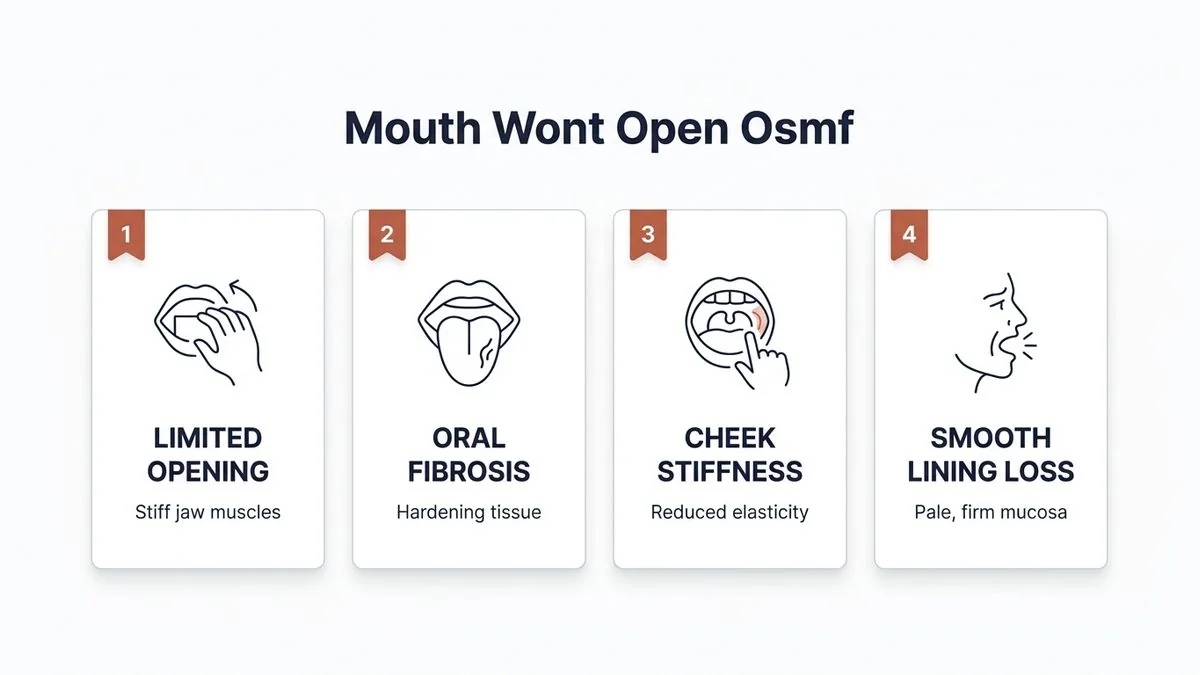
1. Burning Sensation with Spicy Foods (Early Warning Sign)
Long before you notice any physical restriction in your jaw movement, you may experience a persistent burning sensation (intolerance to spices) when consuming spicy, salty, or acidic foods. In Chennai, where rich, spiced curries are a dietary staple, this symptom is highly noticeable. The burning occurs because the protective outer layer of your oral lining (the epithelium) becomes thin, inflamed, and highly sensitive, leaving the nerve endings exposed to chemical irritants.
2. Blanching of the Oral Mucosa (Marble-like Appearance)
If you look into a mirror and examine the inside of your cheeks, healthy tissue should appear pink, moist, and vascular. In patients with OSMF, the tissue undergoes blanching. It loses its healthy pink color and takes on a pale, white, or marble-like appearance. This change happens because the dense collagen deposits compress the local blood vessels, severely reducing blood flow to the oral tissues.
3. Progressive Reduction in Mouth Opening (Inter-incisal Distance)
The most debilitating symptom of OSMF is the steady decrease in your inter-incisal distance—the distance between your upper and lower front teeth when your mouth is open as wide as possible.
-
Normal Opening: A healthy individual can comfortably open their mouth between 35 mm and 50 mm (approximately the width of three of their own fingers held vertically).
-
Restricted Opening: As the fibrous bands tighten, this distance shrinks to two fingers, then one finger, and in advanced cases, to less than 10 millimeters, making solid food consumption impossible.
4. Loss of Tongue Mobility and Depapillation
OSMF does not just affect the cheeks; it can also involve the tongue and the floor of the mouth. Fibrous bands can form under the tongue, tethering it to the floor of the mouth. This severely restricts tongue protrusion and lateral movement, leading to difficulties in speech, swallowing, and clearing food debris from the teeth. Additionally, the normal texture of the tongue is lost as the taste buds (papillae) atrophy, resulting in a smooth, red, and sensitive tongue surface.
The Primary Cause: Areca Nut & Gutka
OSMF has one overwhelming cause: chewing areca nut (betel nut) and its commercial forms — gutka, pan masala and mawa. The alkaloids in areca nut (mainly arecoline) drive the cells in your cheeks to overproduce collagen, while its tannins and copper stop that collagen from breaking down normally. The result is a steady build-up of stiff, inelastic scar bands that progressively limit how wide you can open.
Adding tobacco and alcohol makes it worse — they accelerate the tissue damage and raise the risk of cancerous change. This is why stopping the habit completely is the single most important step in treatment.
Staging of Oral Submucous Fibrosis and Restricted Mouth Opening
In our clinical practice in Chennai, we classify the severity of OSMF based on both the physical symptoms and the measured mouth opening. This staging system guides our multidisciplinary treatment planning, helping us determine whether conservative therapies will suffice or if advanced surgical intervention is required.
| OSMF Stage | Inter-Incisal Distance (Mouth Opening) | Clinical Features & Tissue Changes | Functional Impact & Dietary Limits |
|---|---|---|---|
| Stage I (Early) | Greater than 35 mm | Mild burning sensation, localized mucosal inflammation, slight blanching, no palpable bands. | Normal chewing; minor discomfort with spicy or very hot foods. |
| Stage II (Moderate) | 25 mm to 35 mm | Palpable fibrous bands in the cheeks, moderate blanching, loss of cheek elasticity, slight tongue restriction. | Difficulty eating larger food portions; patient must cut food into smaller pieces. |
| Stage III (Severe) | 15 mm to 24 mm | Dense, rigid fibrous bands in cheeks and soft palate, marked blanching, restricted tongue protrusion. | Inability to eat solid foods; restricted to soft diets (porridge, mashed rice); impaired oral hygiene. |
| Stage IV (Very Severe) | Less than 15 mm | Near-complete jaw lock, rigid oral cavity, severe mucosal atrophy, often accompanied by leukoplakia or erythroplakia. | Liquid diet dependency; severe speech impediment; impossible to perform routine dental care. |
Is OSMF Cancer? Understanding the Malignant Transformation Rate
One of the most frequent and anxiety-inducing questions patients ask us during consultations at Apollo Main Hospital, Greams Road, is: "Is this stiffness a sign of mouth cancer?"
It is vital to clarify that Oral Submucous Fibrosis is not cancer. However, it is classified by the World Health Organization (WHO) as an Oral Potentially Malignant Disorder (OPMD).
OSMF as an Oral Potentially Malignant Disorder (OPMD)
An OPMD is a chronic clinical condition that carries a statistically significant risk of transforming into oral cancer over time. Clinical studies indicate that the malignant transformation rate of OSMF ranges from 7% to 13% [1]. This means that out of every 100 individuals diagnosed with OSMF, up to 13 may eventually develop oral squamous cell carcinoma (OSCC) if the condition is left unmonitored and the causative habits continue. You can read more about how we manage these high-risk conditions on our Oral Precancer (OPMD) page.
Red Flag Symptoms of Progression to Oral Cavity Cancer
Because OSMF alters the normal structure of the oral tissues, early cancerous changes can easily be missed or mistaken for routine fibrotic patches. Patients with OSMF must remain highly vigilant and seek immediate evaluation from an oral and maxillofacial surgeon if they notice any of the following "red flag" symptoms:
-
Non-Healing Ulcers: Any sore, ulcer, or break in the oral lining that does not heal within 10 to 14 days, even after stopping causative habits.
-
Red or White Patches: The appearance of velvety red patches (erythroplakia) or thick, rough white patches (leukoplakia) on top of the blanched tissues.
-
Unexplained Bleeding: Spontaneous bleeding from the oral cavity without an obvious dental cause.
-
Rapid Increase in Stiffness: A sudden, unexplained drop in mouth opening over a short period.
-
Lumps or Swellings: The development of a hard lump or growth in the cheek, tongue, or neck (swollen lymph nodes).
If a malignant change does occur, early detection is what saves lives — which is why ongoing surveillance matters. You can read about treatment for confirmed disease on our oral cancer surgery page.
How OSMF Is Diagnosed
Diagnosis is straightforward: the surgeon takes a history (especially areca nut/tobacco use), measures your maximum mouth opening (inter-incisal distance) to grade severity, and gently feels for the fibrous bands in the cheeks and palate. If any patch looks suspicious, a small biopsy under local anaesthetic confirms whether there are pre-cancerous changes — so your care can be tailored accurately.
Can Restricted Mouth Opening Be Improved?
The good news is that, caught early, OSMF can often be controlled — and even advanced cases can regain useful mouth opening. The right path depends on your stage:
-
Early stages (I–II): the priority is stopping areca nut/tobacco completely, plus antioxidants (such as lycopene) and daily jaw-stretching physiotherapy to halt progression and improve flexibility.
-
Moderate stages: localized injections into the fibrous bands can soften them and improve opening.
-
Advanced stages (III–IV): when the mouth opening is severely limited, surgery to release the fibrous bands — with a tissue graft to keep the area supple — restores function, followed by intensive jaw physiotherapy.
We've explained the full surgical approach, recovery and physiotherapy on our dedicated OSMF release surgery page, and how OSMF fits within precancer care on our oral precancer (OPMD) page. The key takeaway: the earlier OSMF is treated, the more mouth opening can be preserved — so don't wait for it to worsen.
Talk to a Specialist in Chennai
OSMF is progressive — the earlier it's assessed, the more mouth opening can be saved. At Mouth Cancer Surgeons, Dr. Pradeep S. and Dr. Kalpa Pandya jointly review every case, from diagnosis through long-term surveillance, at Apollo Main Hospital, Greams Road, Chennai.
If you have jaw stiffness, burning on spicy food, or a history of areca nut use, don't wait. Book an appointment for a clinical evaluation.
References
-
Wollina, Uwe, et al. "Oral Submucous Fibrosis: An Update on Etiopathogenesis, Diagnosis, and Management." The Journal of Clinical and Aesthetic Dermatology, 2021.
-
World Health Organization. "Control of Oral Cancer and Precancer: Report of a WHO Meeting." WHO Technical Report Series, 2019.
-
Arakeri, Gururaj, et al. "Malignant Transformation of Oral Submucous Fibrosis: A Systematic Review of Clinical and Histopathological Risk Factors." Oral Oncology, 2020.
-
Ray, Jay Gopal, et al. "Efficacy of Lycopene in the Management of Oral Submucous Fibrosis: A Randomized Clinical Trial." Journal of Oral and Maxillofacial Pathology, 2018.
-
National Comprehensive Cancer Network (NCCN). "Clinical Practice Guidelines in Oncology: Head and Neck Cancers." Version 2.2024. [https://www.nccn.org]
Next step
Concerned about a symptom you read here? Get a specialist opinion in Chennai.
Dr. Pradeep S. and Dr. Kalpa Pandya consult at Apollo Hospitals, Greams Road. Same-day responses on WhatsApp for most enquiries.

Dr. Pradeep S.
MDS (OMFS) · FHNS · FIBCSOMS

Dr. Kalpa Pandya
MDS (OMFS) · FHNS — Head & Neck Oncology
Authored by
Medically reviewed by