Can Oral Cancer Be Treated Without Surgery in Chennai?
Need expert consultation? Book an appointment with Dr. Pradeep S. or Dr. Kalpa Pandya.
Book AppointmentReceiving a diagnosis of oral cancer or discovering a suspicious, non-healing ulcer in the mouth is an incredibly stressful experience. For many patients and their families, the immediate fear of major surgery—which may involve removing portions of the jaw or tongue—coupled with the anticipated side effects of radiation and chemotherapy, prompts an urgent question: can oral cancer be treated without surgery radiation chemotherapy?
It is entirely natural to search for gentler, less invasive alternatives. Patients often worry about facial appearance, the ability to speak and swallow, and the overall toll that aggressive oncological treatments take on the body.
In our practice at Mouth Cancer Surgeons in Chennai, Dr. Pradeep S. and Dr. Kalpa Pandya meet many patients seeking non-surgical pathways. This comprehensive guide explores the scientific reality of oral cancer treatment, evaluates where non-surgical therapies fit, and explains how early intervention can help you avoid highly invasive procedures.
Why the "Standard Trio" Remains the Gold Standard
To understand if oral cancer can be treated without surgery, radiation, or chemotherapy, we must first look at why these three modalities form the backbone of international treatment guidelines, such as those from the National Comprehensive Cancer Network (NCCN).
Oral squamous cell carcinoma (OSCC), which accounts for over 90% of all mouth cancers, is an aggressive disease. It tends to invade local tissues deeply and spread relatively early to the lymph nodes in the neck.
Surgery: The Definitive Cure for Localized Disease
For the vast majority of oral cavity cancers, surgical removal of the tumor with a clear margin of healthy tissue remains the single most effective way to achieve a cure. When the cancer is caught early (Stage I or II), a highly precise, localized excision is often all that is required.
Radiation Therapy: Destroying Microscopic Disease
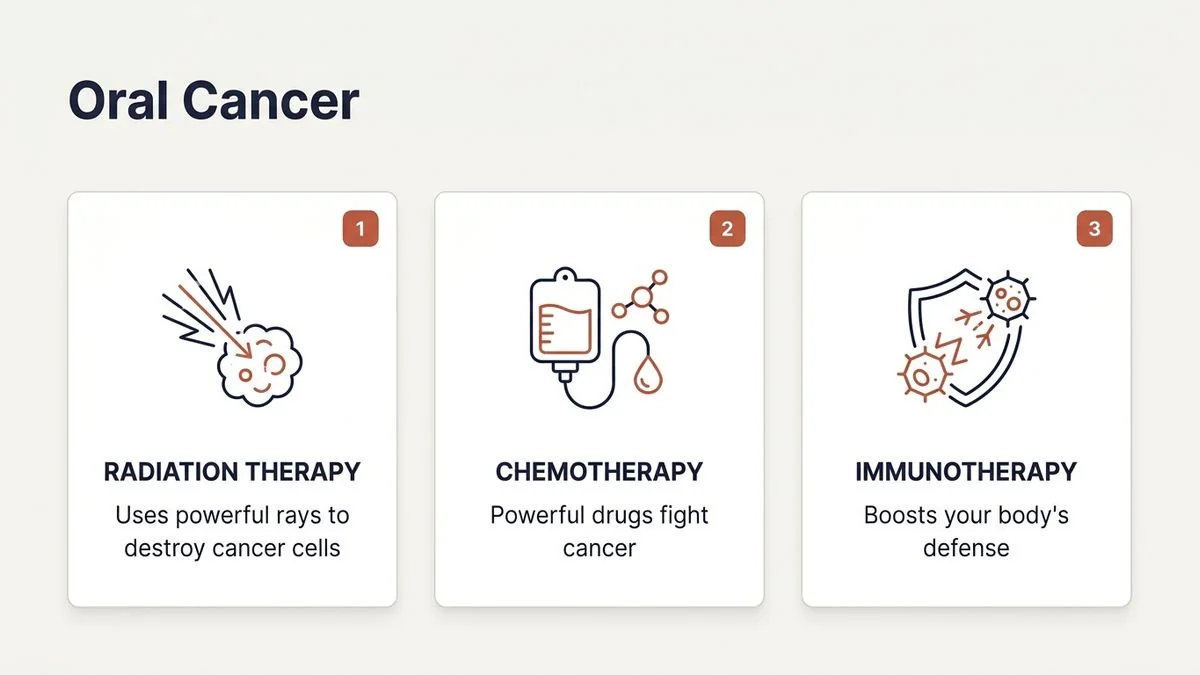
Radiation uses high-energy beams to target and kill remaining cancer cells. It is typically used as an adjuvant (additional) treatment after surgery if the pathology report reveals high-risk features, such as close margins, perineural invasion, or spread to lymph nodes.
Chemotherapy: The Systemic Multiplier
Chemotherapy uses powerful drugs to destroy rapidly dividing cells throughout the body. In oral cancer, it is rarely used alone. Instead, it is combined with radiation (chemoradiotherapy) to make the radiation more effective, or used to shrink large tumors before surgery.
Can Oral Cancer Be Treated Without Surgery, Radiation, or Chemotherapy?
The direct answer depends entirely on the stage of the disease and whether we are dealing with active, invasive cancer or precancerous tissue.
1. Active, Invasive Oral Cancer (Stage I to IV)
If a biopsy has confirmed invasive oral squamous cell carcinoma, it cannot be cured safely or predictably without at least one, and often a combination, of the standard treatments (surgery, radiation, or chemotherapy).
Attempting to treat invasive oral cancer solely with alternative therapies—such as specialized diets, herbal supplements, acupuncture, or homeopathy—carries an exceptionally high risk. Clinical studies consistently show that patients who choose alternative medicine over standard cancer therapies face a significantly higher risk of disease progression and death.
2. Oral Potentially Malignant Disorders (OPMDs)
There is, however, a crucial window before cancer becomes invasive. Oral Potentially Malignant Disorders (OPMDs) are precancerous conditions that have a statistical risk of transforming into cancer. These include:
-
Leukoplakia: Persistent white patches in the mouth.
-
Erythroplakia: Red, velvety patches that carry a very high risk of malignancy.
-
Oral Submucous Fibrosis (OSMF): A chronic, progressive scarring of the oral mucosa, highly prevalent in India due to areca nut and gutkha chewing.
If you are diagnosed with an OPMD, yes, progression to cancer can often be prevented without major surgery, radiation, or chemotherapy. Under the clinical guidance of Dr. Kalpa Pandya, who leads our OPMD and early-intervention division in Chennai, these conditions are managed using targeted, minimally invasive therapies.
To learn more about identifying these early changes, read our guide on how to spot warning signs in mouth ulcers or explore our detailed resource on oral precancer (OPMD) management.
Advanced Non-Surgical and Targeted Medical Therapies
While traditional chemotherapy is systemic and carries significant side effects, modern oncology has introduced highly targeted medical therapies. While these are "non-surgical" and do not involve traditional chemotherapy, they are still highly specialized medical interventions.
Immunotherapy
Immunotherapy works by helping your body’s own immune system recognize and attack cancer cells. Drugs known as immune checkpoint inhibitors, such as Pembrolizumab and Nivolumab, have transformed the management of advanced head and neck cancers.
-
How it works: Cancer cells often hide from the immune system by sending "stop" signals to immune cells. Immunotherapy blocks these signals, allowing T-cells to destroy the tumor.
-
When it is used: Currently, immunotherapy is primarily approved for recurrent or metastatic oral cancers that do not respond to standard chemotherapy. It is rarely used as a first-line, standalone cure for early-stage oral cancer.
Targeted Therapy
Targeted therapies focus on specific proteins or genetic mutations that allow cancer cells to grow and divide.
-
EGFR Inhibitors: Many oral cancer cells overexpress the Epidermal Growth Factor Receptor (EGFR). Drugs like Cetuximab block this receptor, slowing down tumor growth.
-
Clinical Role: Targeted therapy is often combined with radiation therapy for patients who cannot tolerate the physical toll of standard chemotherapy.
Photodynamic Therapy (PDT)
PDT is an emerging, minimally invasive treatment that uses light-sensitive drugs (photosensitizers) and a specific wavelength of laser light to destroy cancer cells.
-
How it works: The drug is injected or applied topically and absorbed by all tissues, but remains in cancer cells longer than healthy cells. When exposed to the laser, the drug produces a form of oxygen that kills the surrounding cancer cells.
-
Limitations: PDT is highly localized and can only penetrate a few millimeters. Therefore, it is strictly reserved for very superficial, early-stage cancers or widespread precancerous patches.
Comparing Conventional Treatments vs. Emerging Non-Surgical Modalities
| Treatment Modality | Primary Indications | Success / Control Rates (Early Stage) | Common Side Effects | Role in Avoiding Surgery |
|---|---|---|---|---|
| Surgery (Standard) | Stage I to IV Oral Cancers | 80% - 90% cure rate for Stage I | Localized pain, swelling, temporary speech/swallow changes | N/A (This is the primary surgical standard) |
| Radiation (Standard) | Advanced stages; post-surgical high-risk features | High local control when combined with surgery | Dry mouth, loss of taste, difficulty swallowing, osteoradionecrosis | Can sometimes replace surgery in specific pharyngeal or laryngeal cancers, but rarely in the oral cavity. |
| Chemotherapy (Standard) | Advanced, metastatic, or recurrent disease | Used to boost radiation; rarely curative alone | Nausea, hair loss, fatigue, lowered immunity | Used to shrink large tumors to make subsequent surgery less extensive. |
| Immunotherapy | Recurrent, metastatic, or advanced disease | Highly variable; can lead to long-term remission in responders | Immune-related inflammation (colitis, pneumonitis), fatigue | Currently used to manage advanced disease, not as a standalone replacement for early-stage surgery. |
| Targeted Therapy | Advanced head and neck cancers | Moderate improvement in survival when combined with radiation | Skin rash, diarrhea, fatigue | Used alongside radiation when surgery or chemotherapy is not medically feasible. |
| Photodynamic Therapy | Superficial precancers, very early micro-invasive lesions | High success for superficial lesions | Localized pain, extreme sensitivity to light for several weeks | Can successfully treat superficial precancers, completely avoiding the need for scalpel surgery. |
The Danger of Delaying Proven Medical Treatment
In our clinical experience at Apollo Main Hospital, Greams Road, Chennai, we have met patients who delayed seeking professional surgical care because they hoped an alternative, non-surgical treatment would cure them.
Unfortunately, oral cancer does not wait. What begins as a small, highly treatable Stage I ulcer on the side of the tongue can rapidly progress.
The Consequences of Delaying Standard Care:
-
Local Invasion: The tumor grows deeper into the muscles of the tongue, the floor of the mouth, or invades the mandible (jawbone).
-
Lymph Node Spread: Cancer cells break away and travel to the lymph nodes in the neck. Once this occurs, the stage immediately advances to Stage III or IV, and the overall cure rate drops significantly.
-
Complex Reconstruction Required: An early-stage cancer can often be removed through the mouth with minimal impact on speech or swallowing. If the cancer is allowed to grow, the patient will eventually require a major resection, followed by complex reconstructive and restorative surgery using microvascular free flaps (transferring tissue from the forearm or leg to reconstruct the jaw or tongue).
-
Loss of Treatment Options: A tumor that could have been cured with a straightforward surgery may grow to a point where it becomes inoperable, leaving the patient with only palliative care options.
If you are worried about a spot in your mouth, please do not wait. Read more about the importance of routine oral cancer screenings and how catching changes early can save your jaw, your voice, and your life.
How the Stage of Cancer Dictates Your Treatment Pathway
The possibility of minimizing treatment aggressiveness is entirely dependent on how early the disease is diagnosed. This is why we advocate so strongly for early screening and diagnosis.
Stage 0 (Carcinoma in Situ / Severe Dysplasia)
At this stage, abnormal cells are found only in the outermost layer of the oral tissue. They have not invaded deeper structures.
- Can it be treated without major surgery? Yes. These are often managed with minor, superficial procedures such as CO2 laser excision, cryosurgery, or photodynamic therapy. No radiation or chemotherapy is required.
Stage I and II (Early Invasive Cancer)
The tumor is less than 4 cm in size and has not spread to any lymph nodes or distant sites.
-
What is the treatment? Surgical excision is the primary, highly effective treatment. In many cases, if the margins are completely clear and there are no high-risk features, radiation and chemotherapy can be completely avoided.
-
Surgical Impact: Because the tumor is small, the surgical impact on speech, swallowing, and appearance is minimal. Most patients recover quickly without needing complex jaw reconstruction.
Stage III and IV (Advanced Cancer)
The tumor is larger than 4 cm, has grown into deep surrounding structures (like bone or deep muscle), or has spread to the lymph nodes in the neck.
-
What is the treatment? Multidisciplinary treatment is essential. This almost always involves a combination of major surgery (often with microvascular reconstruction) followed by adjuvant radiation therapy or chemoradiotherapy.
-
Can any of these be skipped? Skipping any of these recommended modalities in advanced stages drastically increases the risk of the cancer returning (recurrence), which is much harder to treat.
For a deeper understanding of how oral cancers are classified and treated based on their location, view our guides on floor of mouth cancer and the various types of oral cancer.
The Dual-Surgeon Model: Why Who Treats You Matters
When facing an oral cancer diagnosis, your choice of surgical team is one of the most critical decisions you will make. At Mouth Cancer Surgeons, we operate under a unique, patient-centric dual-surgeon model.
Dr. Pradeep S. and Dr. Kalpa Pandya work together as a cohesive team to manage every patient's care from the initial diagnostic biopsy through complex surgery, reconstruction, and long-term surveillance.
-
Dr. Pradeep S. (MDS, FHNS, FIBCSOMS) is an internationally board-certified oral and maxillofacial surgeon with over 15 years of dedicated experience in head and neck surgical oncology. He leads our complex tumor resections and advanced microvascular reconstructive procedures at Apollo Main Hospital, Greams Road, Chennai.
-
Dr. Kalpa Pandya (BDS, MDS, FHNS) brings over 10 years of clinical experience, having cared for more than 1000 oral cancer patients. She leads our OPMD management, facial trauma care, and post-cancer dental implant rehabilitation, ensuring that patients do not just survive, but recover their ability to eat, speak, and smile with confidence.
By having two highly specialized oral and maxillofacial surgeons collaborate on every case, our patients benefit from double the expertise, shortened surgical times (as one surgeon can prepare the reconstructive flap while the other performs the tumor resection), and highly personalized, continuous care.
If you are seeking a second opinion or want to discuss your treatment options, you can consult both surgeons at Apollo Main Hospital, Greams Road, Chennai.
"If you are experiencing a persistent mouth ulcer, a white or red patch, or difficulty opening your mouth, early clinical evaluation is essential. Book an appointment with Dr. Pradeep S. and Dr. Kalpa Pandya at Apollo Main Hospital, Greams Road, Chennai."
What to Do If You Suspect Oral Cancer
If you have a non-healing ulcer, a growing lump, or an unexplained red or white patch in your mouth, follow these steps immediately:
-
Do Not Panic, but Do Not Ignore It: Many oral lesions are benign (non-cancerous) or precancerous. However, only a specialist can make an accurate determination.
-
Avoid Self-Medicating: Applying topical gels, taking random antibiotics, or trying home remedies will only delay an accurate diagnosis.
-
Schedule an Expert Consultation: Seek an evaluation from a qualified oral and maxillofacial surgeon who specializes in head and neck oncology.
-
Undergo a Biopsy if Recommended: A biopsy is a simple, quick, in-clinic procedure where a tiny sample of the tissue is taken and examined under a microscope. It is the only definitive way to diagnose oral cancer. A biopsy does not cause the cancer to spread.
-
Discuss Your Options Openly: If a lesion is found, discuss the stage, the recommended treatment plan, and how to minimize invasiveness while ensuring a complete cure.
To learn more about what to expect during your initial diagnostic journey, read our detailed article on whether oral cancer is curable and our breakdown of oral cancer treatment costs and pathways.
References
-
National Comprehensive Cancer Network (NCCN). "Clinical Practice Guidelines in Oncology: Head and Neck Cancers." NCCN Guidelines, 2024. https://www.nccn.org
-
Warnakulasuriya, Saman. "Clinical features and presentation of oral potentially malignant disorders." Journal of Oral Pathology & Medicine, 2018.
-
Johnson, D. E., et al. "Head and neck squamous cell carcinoma." Nature Reviews Disease Primers, 2020.
-
Indian Council of Medical Research (ICMR). "Consensus Document for the Management of Buccal Mucosa Cancer." ICMR Guidelines, 2022.
-
National Cancer Institute (NCI). "Immunotherapy to Treat Cancer." NCI Resources, 2023. https://www.cancer.gov
Next step
Concerned about a symptom you read here? Get a specialist opinion in Chennai.
Dr. Pradeep S. and Dr. Kalpa Pandya consult at Apollo Hospitals, Greams Road. Same-day responses on WhatsApp for most enquiries.
Dr. Pradeep S.
MDS (OMFS) · FHNS · FIBCSOMS

Dr. Kalpa Pandya
MDS (OMFS) · FHNS — Head & Neck Oncology
Authored by
Medically reviewed by